
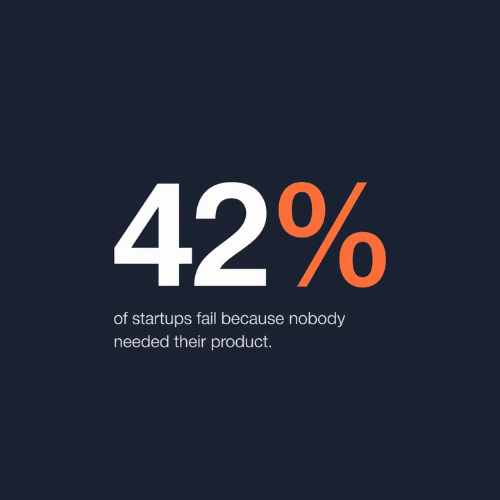
That’s the share of startups that fail — not because they ran out of money, not because competition crushed them — but because they built something the market simply didn’t need. According to CB Insights’ ongoing analysis of startup post-mortems, “no market need” has held the top spot as the #1 cause of startup failure for years running. (CB Insights via Founders Forum, 2025)
And the brutal part? Most of those founders thought they had validated their idea. They had feedback from friends. They had a promising survey. They had enthusiasm.
What they didn’t have was a real understanding of whether the market had an urgent, painful, funded problem — and whether their solution was the right match for it.
That gap is what this article is about.
The Core Question Most Founders Skip
Before anything else — before naming the business, before building a website, before writing a single line of a business plan — there’s one question that needs an honest answer:
Does a real, painful, already-active problem exist in this market? And is someone currently paying — even badly — to solve it?
Notice the word paying. Not “interested in.” Not “would probably use.” Paying.
This distinction alone filters out a massive percentage of bad ideas before they cost anyone a cent.
A real market need has three characteristics:
| Characteristic | What it means in practice |
| Urgent | People are actively searching for a solution right now — not “someday” |
| Painful | The absence of a solution costs them money, time, or peace of mind |
| Funded | Someone, somewhere, is already spending money on an imperfect version of the fix |
If all three exist — you have solid ground. If even one is missing, you need to dig deeper before committing.
Why “People Liked My Idea” Is Not Validation?
Here’s a real pattern I’ve observed in how projects collapse before they launch.
A founder has an idea. They share it with five people. Everyone says something like “that’s a great concept” or “I’d definitely try that.” The founder takes this as a green light and starts building.
Six months and thousands of dollars later — nobody buys.
What went wrong? The feedback was polite, not honest. Friends and family rarely tell you your idea is weak. And even strangers, when asked hypothetically if they’d “use” something, tend to overestimate their actual interest.
The problem isn’t the people. It’s the question being asked.
The right question isn’t “would you use this?” — it’s “walk me through how you currently handle this problem.”
That one shift changes everything. Because if someone has no current process for solving the problem, no money spent on it, and no frustration around it — there’s no real need yet. And you’d rather find that out in a 30-minute conversation than after a full product build.
4 Practical Ways to Find Real Market Needs
1. Structured Conversations With Strangers Not Friends
Talk to 15–20 people who genuinely fit your target audience. The goal isn’t to pitch — it’s to listen. Ask them:
- How do you currently handle [this problem]?”
- “What’s the most frustrating part of that process?”
- “What have you already tried?”
- “What does it cost you when this doesn’t work well?”
If the same frustration surfaces in 7 or 8 out of 10 conversations — unprompted — you’re likely sitting on a real need. If most people shrug, that’s equally valuable data. Uncomfortable, but honest.
2. Follow the Money That’s Already Moving
This is one of the most underused signals available.
If competitors — even mediocre ones — are generating paying customers, that’s proof the need exists. You’re not evaluating the quality of their solution. You’re confirming that people are already willing to pay something to solve this problem.
One-star reviews on competitor products (on G2, Trustpilot, or the App Store) are particularly revealing. When someone takes the time to write a negative review, they’re describing an unmet need in precise detail — essentially handing you a product roadmap for free.
3. Search Behavior Doesn’t Lie
People tell Google things they don’t tell other people.
Tools like Google Trends and AnswerThePublic show you the actual questions people are asking, at what volume, and whether that volume is growing. A rising search trend around a specific pain point is a behavioral signal — far more reliable than a survey.
A founder who checks whether people are actively searching for a solution is doing something most competitors skip entirely.
4. Test With a Simple Landing Page Before You Build
Before spending months building a product, you can validate demand in days.
Create a one-page description of what you’re offering — clear problem, clear solution, clear outcome — and add a single call to action: a waitlist signup, an expression of interest, or a request for early access.
Drive a small amount of targeted traffic to it (even $50–$100 in ads is enough for a directional signal). Then measure: Does anyone click? Does anyone sign up? When you follow up, do they respond?
Dropbox did exactly this in 2008. Before writing a single line of product code, they published a 3-minute demo video. Within 24 hours, over 70,000 people joined a waiting list — proving real demand existed before a dollar was spent on development. (ParallelHQ, 2026)
The Table That Separates Real Needs From False Signals
| Signal | What it actually tells you |
| “My friends love the idea” | Nothing about paying customers |
| Survey: “I’d probably use this” | Interest, not intent — people overestimate willingness to pay |
| Competitor with paying customers | Confirmed: a real need exists in this space |
| Detailed complaints about current solutions | Specific, unfulfilled needs — high-value signal |
| Someone asks “how much does it cost?” | Genuine intent — this is what validation actually feels like |
| Landing page signups + follow-up responses | Early behavioral proof of real demand |
Data Without Financial Modeling Is Just a Story
Here’s something that doesn’t get said enough:
Identifying a real market need is step one. But it doesn’t automatically mean you have a viable business.
You can find 500 people who genuinely need your solution — and still build a company that loses money on every customer if the unit economics (the math behind what it costs to serve one customer vs. what they pay you) don’t work.
This is the part most founders skip. They collect the signals, feel confident, and launch — without ever putting the numbers into a structured model to ask: does this actually work financially?
Collecting market data is necessary. But that data needs to be poured into a flexible financial structure to tell you whether the numbers make a profitable business — or just an interesting idea that costs more to run than it earns.
📘 Stop Random Planning — A Framework Built From Real Lessons
At some point, I got tired of seeing promising ideas fall apart — not because founders lacked motivation, but because nobody gave them a clear, structured process to follow from day one.
That’s what led me to build “Stop Random Planning: A Step-by-Step Framework for Launching Your Project” — a practical guide that walks you through every phase before and at launch: how to identify real market needs, how to validate your idea with real signals, how to position competitively, and how to structure your approach so you’re not building on assumptions.
Every copy includes a free bonus: a 10-page flexible financial Excel model designed specifically for founders at the idea stage. Because gathering market data isn’t enough — you need to see what that data means for your bottom line. The model lets you plug in your numbers and immediately understand whether you’re looking at a profitable business or a structural problem that needs solving before you invest further.
This isn’t a motivational book. It’s a working system.
Already Have an Idea? Let’s Look at It Seriously.
If you’re at the stage where you have a specific concept and want a structured analysis before committing resources, I offer project analysis and feasibility studies — built on the same framework as the guide, applied directly to your specific market and numbers.
💡 Want to go deeper on idea validation?
If you’re unsure whether your current concept is solid enough to move forward, read: How do I know if my project is strong in 2026? — worth reading before or alongside this one.
One Last Thing Worth Saying
Identifying a real market need isn’t glamorous work. It’s conversations, research, small tests, and honest data interpretation. Most people skip it because building feels more productive than questioning.
But the founders who do this work early — the ones who genuinely understand what the market needs, at what urgency, and at what price — those are the ones who launch with confidence instead of hope.
The data from June 2026 is unambiguous: over 150 million startups exist worldwide, $425 billion in venture capital flowed in 2025, and around 90% of startups still fail. (Startup Statistics News, June 2026) The difference between the ones that survive and the ones that don’t isn’t luck. It’s whether they did this work first.
Frequently Asked Questions
Q: What’s the difference between market research and market validation?
Market research tells you about an industry — its size, trends, and players. Market validation (the process of confirming real paying demand for your specific solution) is more focused. Research informs your thinking; validation tests your assumption. Both matter, but most founders spend too much time on research and skip validation entirely.
Q: How many customer conversations do I need before I can trust the findings?
Most practitioners recommend 15–20 conversations with people who genuinely experience the problem — not friends, not family, and not people who are theoretically interested in the topic. By conversation 10 or 12, patterns usually start repeating. That repetition is your signal.
Q: Can I validate market demand using social media polls or group reactions?
You can use them as a directional hint — nothing more. Social engagement measures interest, not intent. The gap between “I’d use that” on social media and “here’s my credit card” is enormous. Treat polls the same way you’d treat a friend saying “sounds cool” — encouraging, but not conclusive evidence of a real market need.
Q: What if I find a real need but there are already many competitors?
Competition is usually a signal of proven demand, not a reason to walk away. The real question is whether you can serve a specific segment meaningfully better than existing options — in terms of price, simplicity, speed, or customer experience. A market full of dissatisfied customers is still a real opportunity.
Q: How do I know if the market need I found is large enough to build a business?
This is exactly where financial modeling becomes essential. A real, urgent need doesn’t automatically translate into a viable business. You need to estimate realistic market size, realistic pricing, and realistic conversion — then run the math to see if the result can sustain and grow a company. The 10-page financial Excel model included with the guide is designed to answer this question using your actual numbers, not estimates pulled from thin air.
Q: Is “Stop Random Planning” suitable for someone with no business background?
Yes. Every concept in the guide is explained in plain language, with practical steps rather than abstract theory. There’s no assumed knowledge of finance, marketing, or business strategy. If you’re starting from zero, that’s exactly who it’s written for.
Sources & References:
- CB Insights Startup Post-Mortem Analysis, via Founders Forum Startup Statistics Guide 2025
- ParallelHQ: What is Market Validation? The Complete 2026 Strategy Guide
- Startup Statistics News June 2026: blog.mean.ceo